

Summer is supposed to be the season of slowing down.
And yet, for most people, it does not actually feel that way. The pace shifts, but the fullness does not. There are trips to plan, schedules to juggle, and an ongoing sense that rest is something to earn rather than something to protect. We collapse at the end of the day and call it recovery. We sleep badly and try to push through. We tell ourselves we will properly rest later, once things calm down.
But here is the thing: things rarely calm down on their own. And what most of us are doing at the end of a long day is not actually rest. Not in the way the body needs.
There is a state the body can enter, deeper than relaxation and more restorative than sleep alone, that researchers are beginning to call deep rest. And emerging science suggests it may be one of the most important things we can offer ourselves.
Your Body Has Never Stopped Trying to Recover
Here is something that does not get talked about enough: your body wants to heal. At every moment, it is working to repair cells, regulate hormones, manage inflammation, support immune function, and maintain the intricate systems that keep you alive and well. But it can only do this work properly when it feels safe enough to do so.
The problem is that modern life has made it very difficult for the body to feel safe.
Stress is not a new human experience. But the scale and constancy of it has changed. We are navigating the same ancient pressures: financial strain, relationship tension, the demands of work and family, while also absorbing a relentless stream of global information that our nervous systems were never designed to process. The result is a body that is almost never fully off duty. One that is perpetually bracing for the next thing, even when there is no immediate threat.
When the stress response is running, everything else gets deprioritized. Digestion slows. Repair pauses. The body burns through energy at a staggering rate. Studies suggest that psychological stress alone can increase energy expenditure by more than half above resting levels. Chronic exposure to stress hormones has been linked to accelerated aging, a weakened immune system, and a significantly increased risk of serious illness.
And yet, exhausted as we are, most of us have very little idea how to truly stop.
The Difference Between Rest and Deep Rest
This is where it gets interesting.
There is rest: lying on the couch, taking a bath, watching something on your phone. These things have value. But researchers studying what they call "deep rest" describe something physiologically distinct: a state in which the body and brain shift into a coordinated mode of genuine recovery. Not simply the absence of activity, but the active presence of safety signals that tell the nervous system: you can let go now.
In this state, the heart rate drops. Inflammation markers decrease. The parasympathetic nervous system, the branch responsible for rest, digestion, and repair, takes over. The body finally gets on with all the maintenance it has been deferring.
The difference between ordinary relaxation and deep rest, according to the researchers who have studied it, is something like the difference between sitting in a car with the engine idling and actually turning it off.
What can bring the body into this state? Practices that share one thing in common: slow, deliberate breathing. Prayer. Meditation. Qigong. Yoga. Gentle movement done with full attention. The specific practice matters less than the outcome, and that outcome is a nervous system that has received the signal that right now, there is nothing to fear.

What Indigenous Wisdom Has Always Known
None of this is new.
Indigenous cultures around the world have long understood that stillness is not laziness. It is medicine. That the body needs ceremony, ritual, and rest in the same way it needs food and water. That moving through the world in a state of constant urgency is not strength. It is a kind of poverty.
The Seven Grandfather Teachings, which guide so much of what we do at Kebaonish, include Humility (Dbaadendziwin) as one of the foundational values of a good life. Humility, in this tradition, is the practice of recognising your place within the whole. Of releasing the need to force, to push, to produce. Of understanding that sometimes, surrender is the most courageous thing you can offer.
There is something quietly radical about a worldview that holds rest as a form of wisdom rather than a failure of productivity.
A Cup That Understands This
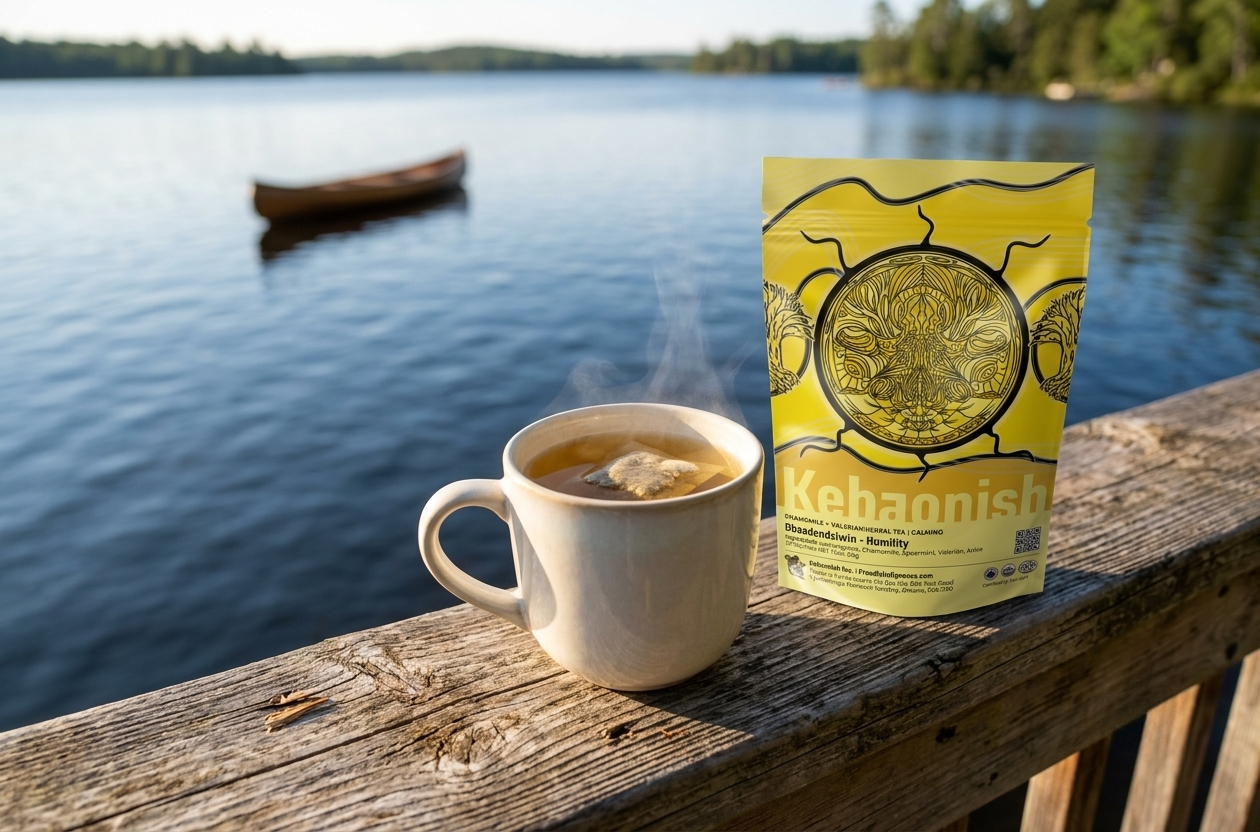
Our Humility Tea was crafted with this understanding at its centre.
Named for the teaching of Dbaadendziwin, this blend was built for the moments when the body needs permission to soften. Its ingredients, lemongrass, chamomile, spearmint, valerian, and anise, each contribute to a single shared purpose: helping the nervous system find its way back to calm.
Chamomile is one of the most well-researched calming herbs in the world, known for its gentle sedative quality and its ability to ease the tension that accumulates in a long day. Valerian, the quiet hero of the blend, has been used for centuries to support restful sleep and deep relaxation, working naturally with the body's own chemistry rather than overriding it. Lemongrass soothes with its citrus warmth. Spearmint eases and refreshes. Anise lends its subtle sweetness while calming the digestive system, which is one of the first places stress shows up in the body.
Together, they create something that is not just pleasant to drink, but genuinely useful. A small, intentional act of care that helps the body receive the signal it needs most: all is well. You can rest now.
Learn more about Valerian in our previous blog here.
How to Actually Rest
The science on deep rest suggests there is no single path. What matters is finding what makes you feel genuinely safe and at ease. A few places to start:
Slow your breath deliberately. Research points to breathing at around six breaths per minute as particularly effective for activating the parasympathetic nervous system. Inhale for five counts, exhale for five. Do this for ten minutes and notice what shifts.
Build a transition ritual. Deep rest does not happen instantly. The nervous system needs time and cues to downshift. A consistent evening ritual, dimming lights, making tea, stepping away from screens, teaches the body that this time is different. That it is safe to let go.
Be still without purpose. Not productively still. Not planning your next day or processing a conversation. Simply present with what is around you: the temperature of the air, the sounds in the room, the warmth in your hands.
Make your space feel safe. Deep rest is, at its root, the body's response to safety signals. What makes you feel held, grounded, and at ease? Lean into that, without guilt.
And if you need somewhere to start, make a cup of tea.
The Quiet Revolution
There is something quietly political about choosing rest in a culture that measures worth by productivity. Something that aligns, perhaps unexpectedly, with Indigenous teachings that have long resisted the idea that doing more is always better.
At Kebaonish, we make teas rooted in traditional knowledge and as a genuine invitation to live differently. The Humility Tea is not a sleep aid in a sachet. It is a small act of alignment with a different set of values. One that says: your body is worth listening to. Your rest is worth protecting. And sometimes, the most powerful thing you can offer the world is a version of yourself that has actually had the chance to recover.
That starts with a cup. It starts with tonight.
→ Shop the Humility (Chamomile + Valerian) Tea: kebaonish.com
→ Explore the full Kebaonish tea collection: kebaonish.com/collections/tea
Kebaonish is an Indigenous-led tea company committed to promoting well-being through traditional knowledge, wisdom, and the spirit of sharing. All teas are organic and ethically sourced. Learn more at kebaonish.com
Share:
First Nations Economic Identity and Reconciliation in Canada: A Complex Landscape
Nibwaakaawin (Wisdom): The First of the Seven Grandfather Teachings